Content and Process Theories
The content theories are concerned with identifying the needs that people have and how needs are prioritized. They are concerned with types of incentives that drive people to attain need fulfillment. The Maslow hierarchy theory, Fredrick Herberg’s two factor theory and Alderfer’s ERG needs theory fall in this category. Although such a content approach has logic, is easy to understand, and can be readily translated in practice, the research evidence points outs our limitations. There is very little research support for these models’ theoretical basis and predictability. The trade off for simplicity sacrifices true understanding of the complexity of work motivation. On the positive side, however, the content models have given emphasis to important content factors that were largely ignored by human relationists. In addition the Alderfer model allows more flexibility and the Herzberg model is useful as an explanation for job satisfaction and as a point of departure for job design.
The process theories provide a much sounder theoretical explanation of work motivations. The expectancy model of Vroom and the extensions and the refinements provided by Porter and Lawler help explain the important cognitive variables and how they relate to one another in the process of work motivation. The Porter Lawler model also gives specific attention to the important relationship between performance and satisfaction. A growing research literature is somewhat supportive of these expectancy models, but conceptual and methodological problems remain. Unlike the content models these expectancy models are relatively complex and difficult to translate into actual practice, and, consequently, they have generally failed to meet the goals of prediction and control of organization behavior.
The process theories are concerned with identifying the variables that go into motivation and more importantly how they are related to one another.
Abraham Maslow theory of need hierarchy:
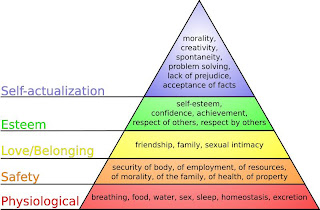
It was Abraham Maslow who thought that human needs that spark off an activity can be arranged in a hierarchy of pre-potency and probability of occurrence. Maslow based his theory that a need that is not satisfied dominates the behavior sparking off an activity for its satisfaction. This need, when satisfied in its turn activates the higher need. This sequence can be denoted as under:
Deprivation -> Domination -> Gratification -> Activation
 Physiological needs
For the most part, physiological needs are obvious - they are the literal requirements for human survival. If these requirements are not met, the human body simply cannot continue to function.
Physiological needs include:
* Breathing
* Homeostasis
* Water
* Sleep
* Food
* Excretion
* Sex
Safety needs
With their physical needs relatively satisfied, the individual's safety needs take over and dominate their behavior. These needs have to do with people's yearning for a predictable, orderly world in which injustice and inconsistency are under control, the familiar frequent and the unfamiliar rare. In the world of work, this safety needs manifest themselves in such things as a preference for job security, grievance procedures for protecting the individual from unilateral authority, savings accounts, insurance policies, and the like.
Physiological and safety needs are reasonably well satisfied in the "First World". The obvious exceptions, of course, are people outside the mainstream — the poor and the disadvantaged. If frustration has not led to apathy and weakness, such people still struggle to satisfy the basic physiological and safety needs. They are primarily concerned with survival: obtaining adequate food, clothing, shelter, and seeking justice from the dominant societal groups.
Safety and Security needs include:
* Personal security
* Financial security
* Health and well-being
* Safety net against accidents/illness and the adverse impacts
Social needs
After physiological and safety needs are fulfilled, the third layer of human needs is social. This psychological aspect of Maslow's hierarchy involves emotionally-based relationships in general, such as:
* Friendship
* Intimacy
* Having a supportive and communicative family
Humans need to feel a sense of belonging and acceptance, whether it comes from a large social group, such as clubs, office culture, religious groups, professional organizations, sports teams, gangs, or small social connections (family members, intimate partners, mentors, close colleagues, confidants). They need to love and be loved (sexually and non-sexually) by others. In the absence of these elements, many people become susceptible to loneliness, social anxiety, and clinical depression. This need for belonging can often overcome the physiological and security needs, depending on the strength of the peer pressure; an anorexic, for example, ignores the need to eat and the security of health for a feeling of control and belonging.
All humans have a need to be respected, to have self-esteem, self-respect, and to respect. Also known as the belonging need, esteem presents the normal human desire to be accepted and valued by others. People need to engage themselves to gain recognition and have an activity or activities that give the person a sense of contribution, to feel accepted and self-valued, be it in a profession or hobby. Imbalances at this level can result in low self-esteem or an inferiority complex. People with low self-esteem need respect from others. They may seek fame or glory, which again depends on others. It may be noted, however, that many people with low self-esteem will not be able to improve their view of themselves simply by receiving fame, respect, and glory externally, but must first accept themselves internally. Psychological imbalances such as depression can also prevent one from obtaining self-esteem on both levels.
Self-transcendence
Near the end of his life Maslow revealed that there was a level on the hierarchy that was above self-actualization: self-transcendence. "Transcenders may be said to be much more often aware of the realm of Being (B-realm and B-cognition), to be living at the level of Being… to have unitive consciousness and “plateau experience” (serene and contemplative B-cognitions rather than climactic ones) … and to have or to have had peak experience (mystic, sacral, ecstatic) with illuminations or insights.
The motivation to realize one's own maximum potential and possibilities is considered to be the master motive or the only real motive, all other motives being its various forms. In Maslow's hierarchy of needs, the need for self-actualization is the final need that manifests when lower level needs have been satisfied.
The content theories are concerned with identifying the needs that people have and how needs are prioritized. They are concerned with types of incentives that drive people to attain need fulfillment. The Maslow hierarchy theory, Fredrick Herberg’s two factor theory and Alderfer’s ERG needs theory fall in this category. Although such a content approach has logic, is easy to understand, and can be readily translated in practice, the research evidence points outs our limitations. There is very little research support for these models’ theoretical basis and predictability. The trade off for simplicity sacrifices true understanding of the complexity of work motivation. On the positive side, however, the content models have given emphasis to important content factors that were largely ignored by human relationists. In addition the Alderfer model allows more flexibility and the Herzberg model is useful as an explanation for job satisfaction and as a point of departure for job design.
The process theories provide a much sounder theoretical explanation of work motivations. The expectancy model of Vroom and the extensions and the refinements provided by Porter and Lawler help explain the important cognitive variables and how they relate to one another in the process of work motivation. The Porter Lawler model also gives specific attention to the important relationship between performance and satisfaction. A growing research literature is somewhat supportive of these expectancy models, but conceptual and methodological problems remain. Unlike the content models these expectancy models are relatively complex and difficult to translate into actual practice, and, consequently, they have generally failed to meet the goals of prediction and control of organization behavior.
The process theories are concerned with identifying the variables that go into motivation and more importantly how they are related to one another.
Abraham Maslow theory of need hierarchy:
It was Abraham Maslow who thought that human needs that spark off an activity can be arranged in a hierarchy of pre-potency and probability of occurrence. Maslow based his theory that a need that is not satisfied dominates the behavior sparking off an activity for its satisfaction. This need, when satisfied in its turn activates the higher need. This sequence can be denoted as under:
Deprivation -> Domination -> Gratification -> Activation

For the most part, physiological needs are obvious - they are the literal requirements for human survival. If these requirements are not met, the human body simply cannot continue to function.
Physiological needs include:
* Breathing
* Homeostasis
* Water
* Sleep
* Food
* Excretion
* Sex
Safety needs
With their physical needs relatively satisfied, the individual's safety needs take over and dominate their behavior. These needs have to do with people's yearning for a predictable, orderly world in which injustice and inconsistency are under control, the familiar frequent and the unfamiliar rare. In the world of work, this safety needs manifest themselves in such things as a preference for job security, grievance procedures for protecting the individual from unilateral authority, savings accounts, insurance policies, and the like.
Physiological and safety needs are reasonably well satisfied in the "First World". The obvious exceptions, of course, are people outside the mainstream — the poor and the disadvantaged. If frustration has not led to apathy and weakness, such people still struggle to satisfy the basic physiological and safety needs. They are primarily concerned with survival: obtaining adequate food, clothing, shelter, and seeking justice from the dominant societal groups.
Safety and Security needs include:
* Personal security
* Financial security
* Health and well-being
* Safety net against accidents/illness and the adverse impacts
Social needs
After physiological and safety needs are fulfilled, the third layer of human needs is social. This psychological aspect of Maslow's hierarchy involves emotionally-based relationships in general, such as:
* Friendship
* Intimacy
* Having a supportive and communicative family
Humans need to feel a sense of belonging and acceptance, whether it comes from a large social group, such as clubs, office culture, religious groups, professional organizations, sports teams, gangs, or small social connections (family members, intimate partners, mentors, close colleagues, confidants). They need to love and be loved (sexually and non-sexually) by others. In the absence of these elements, many people become susceptible to loneliness, social anxiety, and clinical depression. This need for belonging can often overcome the physiological and security needs, depending on the strength of the peer pressure; an anorexic, for example, ignores the need to eat and the security of health for a feeling of control and belonging.
All humans have a need to be respected, to have self-esteem, self-respect, and to respect. Also known as the belonging need, esteem presents the normal human desire to be accepted and valued by others. People need to engage themselves to gain recognition and have an activity or activities that give the person a sense of contribution, to feel accepted and self-valued, be it in a profession or hobby. Imbalances at this level can result in low self-esteem or an inferiority complex. People with low self-esteem need respect from others. They may seek fame or glory, which again depends on others. It may be noted, however, that many people with low self-esteem will not be able to improve their view of themselves simply by receiving fame, respect, and glory externally, but must first accept themselves internally. Psychological imbalances such as depression can also prevent one from obtaining self-esteem on both levels.
Self-transcendence
Near the end of his life Maslow revealed that there was a level on the hierarchy that was above self-actualization: self-transcendence. "Transcenders may be said to be much more often aware of the realm of Being (B-realm and B-cognition), to be living at the level of Being… to have unitive consciousness and “plateau experience” (serene and contemplative B-cognitions rather than climactic ones) … and to have or to have had peak experience (mystic, sacral, ecstatic) with illuminations or insights.
The motivation to realize one's own maximum potential and possibilities is considered to be the master motive or the only real motive, all other motives being its various forms. In Maslow's hierarchy of needs, the need for self-actualization is the final need that manifests when lower level needs have been satisfied.

